01 / Before each day
The coursebook
Review the anatomy before you arrive. Each level has its own coursebook, with region sheets, clinical cases and knowledge checks to prepare you for the workshop.
View the curriculum
Trigger Release Injection Guide for GP, Emergency and Rural Education and Documentation
Clinical education for physicians
Anatomy, clinical reasoning and patient safety across 25 regions. Three progressive workshop days in Vancouver, with the coursebook for each level emailed before its workshop.
Led by Dr. J. Chhina
9 years of trigger point injection experience.
For physicians licensed in British Columbia. Educational completion is distinct from clinical readiness.

Each level is a separate Saturday workshop. Begin with Level 1; Level 2 requires Level 1, and Level 3 requires Level 2.
1
Level 1 day / 8 regions
Start with common neck, shoulder, low-back and gluteal presentations. Complete the foundations before attending.
2
Level 2 day / 10 regions
Extend your assessment to selected thoracic, shoulder, limb and jaw regions. Requires Level 1.
3
Level 3 day / 7 regions
Work through complex anatomy, risk and referral decisions. Requires Level 2.
12 physicians per day. Dates and final booking terms will be published before registration opens.
Recognise the muscle component
Myofascial pain affects muscles and the fascia, the connective tissue around them. A sensitive spot within a taut muscle band, often called a trigger point, can reproduce familiar pain when pressed.
Pain may stay near that spot or be felt elsewhere, known as referred pain. Stiffness and restricted movement can accompany it. Clinical assessment helps distinguish a muscle contribution from joint, nerve and other causes.
Read more about myofascial pain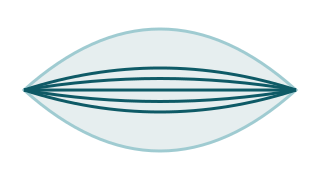
Assessment begins with the history and examination.
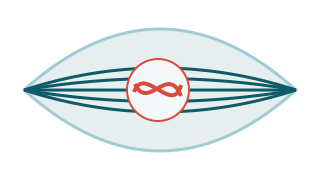
Pressure may reproduce the patient's familiar pain.
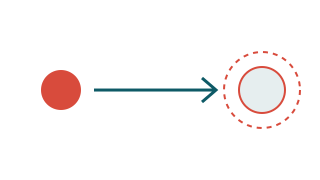
The painful area and the source may be different.
These are conceptual illustrations, not anatomical maps or injection guides.
Understand the role of trigger point injections01 / Before each day
Review the anatomy before you arrive. Each level has its own coursebook, with region sheets, clinical cases and knowledge checks to prepare you for the workshop.
View the curriculum02 / In person
Connect patient selection and pre-treatment assessment with anatomy, technique, consent and danger areas. Work through simulation, clinical cases, documentation and billing principles.
Careful decisions. Clear limits.
Every learner receives simulation practice. Clinical cases connect patient selection, anatomy, safety and documentation.
Live clinical participation depends on patient need, consent and individual readiness. A live injection is not guaranteed.
Explore the workshop format